
Why ‘You Can’t Protect What You Can’t See’ Is the Biggest Risk for SMEs and Enterprises in 2026

In an era where hybrid and cloud environments dominate IT landscapes, cybersecurity visibility has never been more critical. As SMEs and enterprise IT managers grapple with expanding attack surfaces, the old adage “you can’t protect what you can’t see” rings truer than ever. With previous year 2025 global cybercrime which was projected to reach $10.5 trillion annually, and likely escalating in 2026, blind spots in IT monitoring are leaving organisations vulnerable to undetected threats. This blog explores the dangers of IT monitoring blind spots, real-world breach examples, and the pains of reactive security, emphasising why proactive enterprise threat detection is essential for robust cybersecurity visibility.
Understanding Blind Spots in Hybrid and Cloud Environments
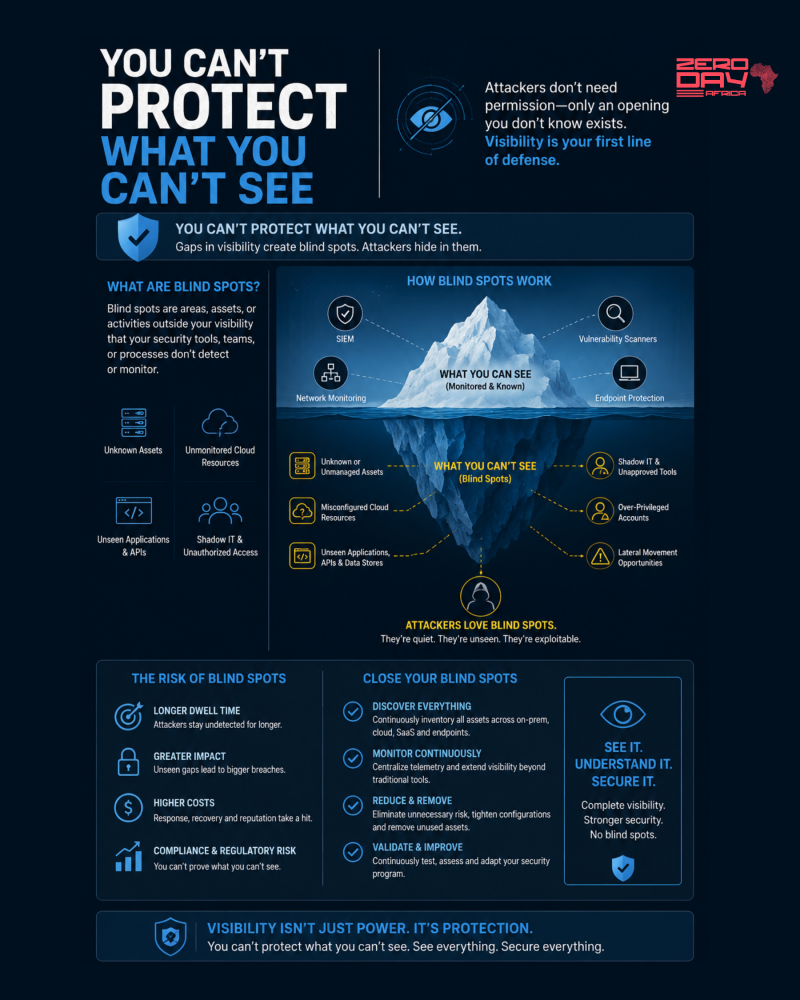
Hybrid cloud security combines on-premises infrastructure with public and private clouds, offering flexibility but introducing significant cybersecurity visibility challenges. As organisations migrate to these setups, blind spots emerge from encrypted traffic, micro-services, and sprawling architectures that traditional monitoring tools can’t fully capture.
One major issue is the lack of visibility into East-West traffic, the lateral movement within networks that accounts for much of modern threat activity. Nearly half of security leaders report partial or no insight into this traffic, creating hybrid cloud security risks where attackers can dwell undetected. Shadow IT and infrastructure-as-code (IaC) misconfigurations exacerbate this, with unchecked resources leading to configuration drift and exploitable gaps.
In cloud environments, shared responsibility models often lead to overlooked vulnerabilities. For instance, while cloud providers secure the infrastructure, customers must handle application-level security, yet many fail to adapt legacy controls, resulting in blind spots that threat actors exploit. As AI-powered threats accelerate in 2026, these IT monitoring blind spots in hybrid setups will only widen without unified visibility tools.
Real-World Breach Examples Highlighting Visibility Failures
History is littered with breaches stemming from poor cybersecurity visibility, and 2025 saw no shortage of examples that foreshadow risks for 2026. Take the TJX breach, where hackers exploited weak Wi-Fi encryption to access systems undetected, moving freely due to inadequate network segmentation. Similarly, Equifax’s massive data exposure resulted from unpatched vulnerabilities and poor visibility, allowing intruders to navigate servers without alerts.
In 2025, the NPD incident highlighted fundamental security lapses, including limited database controls, leading to operational collapse. Ransomware featured in 44% of analysed incidents, often thriving in environments with delayed detection, attackers lingered for weeks or months due to visibility gaps. Harvard and other institutions faced education-sector breaches tied to third-party access and poor monitoring, underscoring how hybrid cloud security blind spots enable widespread damage.
Our Zero Day Africa Report, Q1 edition, highlighted a critical data exposure incident in March 2026. Virgin Active South Africa disclosed this vulnerability due to a web application logic flaw in its payment request system. The flaw, identified as Insecure Financial Data: Partial bank details, payment history and Direct Object Reference (IDOR) within its Netcash integration, allowed unauthorised users to access sensitive member data without authentication. This breach wasn’t caused by sophisticated malware or zero-day exploitation but rather weak access control design, revealing systemic issues in secure application development. Over 631,000 members were potentially affected, posing significant risks of fraud and targeted phishing.
These cases illustrate a pattern: without comprehensive enterprise threat detection, breaches escalate from minor intrusions to multimillion-dollar disasters, emphasising the need for real-time visibility in hybrid environments.
The High Cost of Reactive Security
Reactive security (responding after threats materialise) inflicts severe financial and operational pain on SMEs and enterprises. The average data breach cost hit $4.45 million in recent reports, with industrial sectors facing even higher figures at $5.56 million. Ransomware claims alone averaged $1.18 million in 2025, a sharp rise from previous years, driven by undetected lateral movements in blind spots.
Beyond direct costs, reactive approaches lead to unplanned downtime costing up to $125,000 per hour, plus reputational damage and regulatory fines. Proactive strategies, by contrast, reduce breach costs by up to $2.22 million through AI-driven prevention and cut total expenses by 25% over three years compared to reactive models. Yet 46% of companies still lack visibility into their breach frequency, perpetuating a cycle of cascading vulnerabilities.
In recent times, with AI amplifying threats, clinging to reactive security will amplify these pains, making IT monitoring blind spots not just a risk, but a liability.
Moving Toward Proactive Visibility: A Path Forward
As we’ve seen, blind spots in hybrid and cloud environments fuel breaches and inflate the costs of reactive security. SMEs and enterprise IT managers can’t afford to wait for alerts that never come. That’s where managed monitoring solutions shine, offering continuous threat intelligence, log analysis, and incident response to illuminate hidden risks.
